
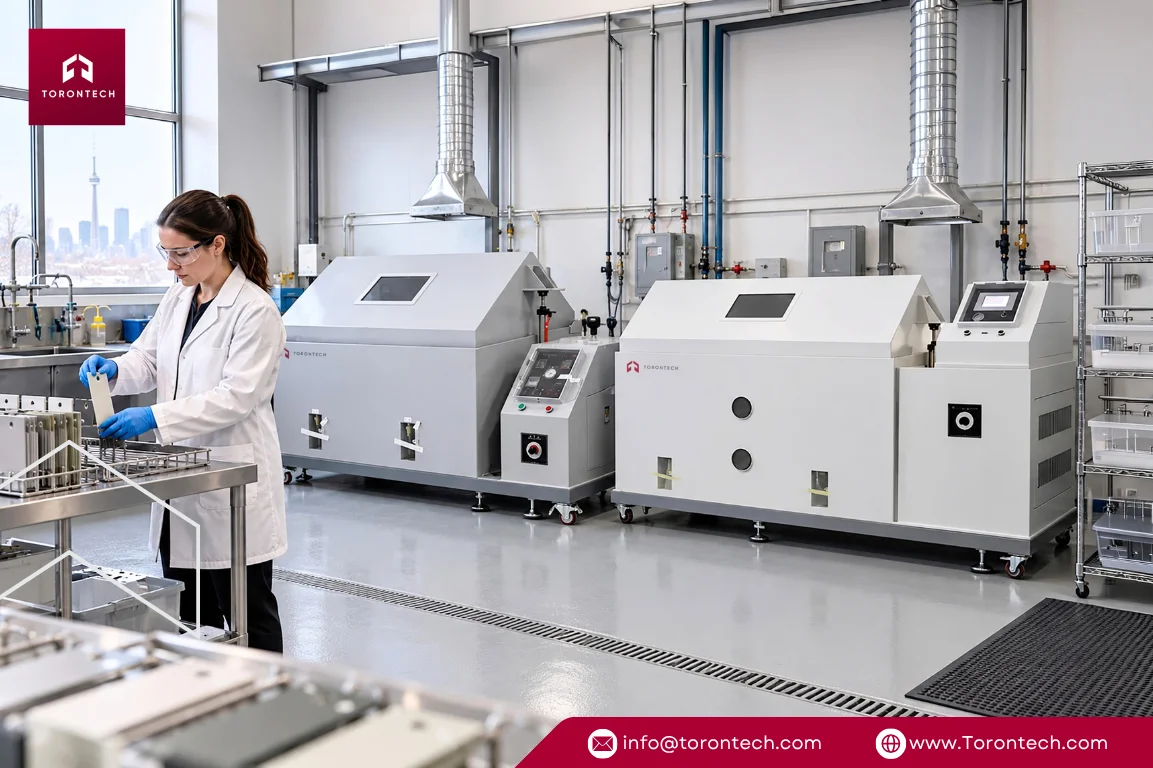
Salt Spray Chamber Buyer's Guide & Lab Checklist
How much does premature surface corrosion cost your operation in warranty claims and compromised client trust? Accelerated testing prevents these field failures by compressing years of severe coastal exposure and highway salts into a matter of days.
This direct salt spray chamber buyer’s guide covers key standards, sizing, and lab setup to show you how to choose the right salt spray chamber when choosing salt spray chamber equipment for your facility.
Key Takeaways
- Match Your Standards Early: Identify whether your quality protocols require steady-state salt fog (ASTM B117, ISO 9227) or dynamic cyclic environmental testing (SAE J2334, GMW14872, ASTM G85).
- Prioritize Non-Corrosive Materials: Choose heavy-gauge compression-molded PVC and titanium-alloy heating elements over lined sheet metal to prevent internal peeling, corrosion, and sample contamination.
- Plan Capacity with Growth in Mind: Ensure your chamber accommodates standard 15° to 30° specimen mounting angles while maintaining a 20% to 30% volume buffer for larger production batches (such as Torontech TTSS models ranging from 108 L to 1,440 L).
- Confirm Lab Infrastructure Before Ordering: Verify dedicated oil-free compressed air (1.0 to 2.0 bar), high-purity deionized water (conductivity under 5.0 µS/cm), acid-resistant PVC exhaust ducting, and compatible 60 Hz electrical hookups.
- Control Daily Solution Parameters: Maintain strict test repeatability by verifying daily specific gravity (1.0255 to 1.0400 at 25°C), solution pH (6.5 to 7.2 for NSS), and standard fallout collection rates (1.0 to 2.0 mL per 80 cm² per hour).
Test Standards & Industry Specifications
Before reviewing equipment specifications, we recommend confirming the exact testing standards required by your clients and quality management framework.
Neutral Salt Spray (NSS)
The dominant benchmark worldwide is ASTM B117, which specifies continuous exposure to a 5% sodium chloride (NaCl) fog at a sustained 35°C (95°F), with solution acidity maintained between pH 6.5 and 7.2 and a verified fog collection rate of 1 to 2 mL/h per 80 cm².
In our view, NSS remains the most reliable baseline screening method for standard coatings and passivated metals. The ISO 9227 framework provides a comparable international structure. While revisions since 2006 refined cabinet tolerances and corrosivity verification, modern laboratories align with the active ISO 9227:2022 edition, which establishes the strictest reference-specimen mass-loss benchmarks to date.
Acetic Acid Salt Spray (AASS)
Introduces glacial acetic acid to bring the solution down to an acidic pH of 3.1 to 3.3. This accelerated environment evaluates zinc die-castings and anodized aluminum finishes quickly by delivering a noticeably more aggressive chemical attack than neutral salt fog.
Copper-Accelerated Salt Spray (CASS)
Adds copper chloride (CuCl2) to an acidified solution at an elevated 50°C (122°F), aggressively attacking electroplated nickel-chrome finishes and decorative automotive trim to reveal coating porosity in short order.
Cyclic Corrosion Testing (CCT)
Alternates between salt fog, dry heat, and controlled relative humidity to simulate dynamic outdoor atmospheric conditions. Across North American manufacturing, major automotive original equipment manufacturers mandate rigorous cyclic protocols, such as General Motors GMW14872, Ford CETP 00.00-L-467, and SAE J2334.
Standard protocols such as ASTM G85 Annex A2 demand precise relative humidity regulation during dwell periods, as minor operational deviations in relative humidity significantly alter corrosion damage. Recent research shows that modern chambers with tight humidity regulation reduce the acceleration ratio spread between metals from 18.6× down to 1.4×, yielding results much closer to real field weathering.
Industry Benchmarks & Test Durations
Exposure requirements vary significantly depending on the operating environment of the finished product.
In the North American automotive manufacturing corridor spanning the US Midwest to Southern Ontario (SAE J2334, GMW14872, ASTM B368), underbody brackets, brake lines, and bright trim are evaluated across 96 to 1,000+ hours. Aerospace and defense contractors following US Department of Defense guidelines (MIL-STD-810H, ASTM B117) subject structural hardware, passivated titanium, and cadmium plating to rigorous 168 to 1,000+ hour evaluations.
Civil infrastructure hardware follows regional transportation mandates, such as American Association of State Highway and Transportation Officials (AASHTO) and ASTM A123 standards for hot-dip galvanized steel rebar, bridge fasteners, and guardrails enforced by US State Departments of Transportation (DOTs) and Canadian Provincial Ministries (such as the Ontario Ministry of Transportation, MTO).
Heavy marine primers and offshore structural coatings (ISO 12944, NORSOK M-501) face the longest trials, frequently running between 720 and 4,000+ hours. Industrial paints (ASTM D1654) are typically screened between 240 and 2,000+ hours, while consumer electronics and fuel cell hardware (IEC 60068-2-11) often undergo targeted marine fog investigations.
Chamber Types: Standard vs. Cyclic Systems
Once your target standards are identified, the primary hardware decision when choosing a salt spray chamber is selecting between a dedicated continuous salt fog unit and an integrated climatic system.
In our view, a dedicated salt fog unit like our TTSS Series represents the most practical, cost-effective choice for standard quality screening. However, if your specifications require cyclic environmental transitions, a combined temperature and humidity system is necessary.
Related article: Salt Spray vs Cyclic Corrosion Testing Guide
| Feature / Capability | Salt Spray Corrosion Test Chamber (TTSS Series) | Temperature & Humidity Salt Spray Chamber |
|---|---|---|
| Primary Testing Mode | Continuous salt fog (NSS, AASS, CASS) | Salt fog alternating with thermal and relative humidity cycles |
| Primary Standards | ASTM B117, ISO 9227, ASTM B368, JIS Z 2371, MIL-STD-810 | ASTM G85, ISO 11997, SAE J2334, GMW14872, Ford CETP 00.00-L-467 |
| Target Application | Production batch verification, electroplating qualification, baseline coating screening | Advanced R&D, OEM automotive cyclic testing, aerospace weathering |
| Environmental Control | Constant chamber temperature (35°C / 50°C) with saturated air bubble tower | Programmed ramp and dwell cycles for temperature (-20°C to +80°C), RH (20% to 98%), and forced air dry-off |
| Instrumentation & Control | Microprocessor PID digital controller (optional 7-inch color touch screen) | Programmable 7-inch color touch-screen controller supporting multi-step cyclic profiles |
| Chamber Construction | Impact-resistant, gray-white PVC board (5 mm or 8 mm) rated to 85°C | Reinforced composite polymer housing with integrated climatic conditioning blowers |
Key Criteria for Choosing a Salt Spray Chamber
When evaluating physical equipment, we recommend focusing on these core engineering and design details:
Chamber Construction Materials
The chamber interior is continuously exposed to hot, acidic salt fog and aggressive chemical condensates. We strongly favor heavy-gauge, gray-white impact-resistant PVC board (utilizing 5 mm sheet thickness on smaller cabinets and 8 mm thickness on larger models) because it naturally resists acids, alkalis, and chlorides without blistering or scratching up to 85°C.
Research confirms that replacing heavy steel structural components with hard industrial PVC reduces overall weight and unit cost while preserving structural rigidity. Conversely, metal cabinets with internal plastic coatings or epoxy linings present long-term reliability risks, as minor surface scratches allow saline solution to penetrate the base metal, leading to internal corrosion and sample contamination.
Fog Atomization & Dispersion Control
Standard test protocols require a verified fallout collection rate between 1.0 and 2.0 mL per hour per 80 cm² of horizontal surface area. Precision atomizing nozzles crafted from quartz glass, paired with an adjustable conical dispersion tower, deliver a uniform, micron-level mist across prolonged test cycles without clogging. The central tower disperses fog evenly throughout the interior without directly spraying test specimens.
Furthermore, fallout monitoring design directly impacts daily lab uptime. While traditional chambers often feature exposed external glass cylinders that are easily bumped and cracked on active laboratory floors, cabinets engineered with built-in, protected collection tubes avoid accidental breakage.
This arrangement allows operators to verify deposition rates reliably without disturbing the sealed internal test atmosphere. Emerging monitoring techniques, such as Raman spectroscopy, are also helping researchers track aerosol concentrations with high precision.
Temperature & Saturation Stability
Accurate thermal regulation requires high-precision microprocessor PID controllers to keep internal cabinet temperatures at 35 ± 2°C for neutral salt fog. For heating elements, we recommend titanium-alloy electric heating tubes, which provide superior corrosion resistance and typically outlast standard stainless steel heaters by 3 to 5 years.
In addition, incoming compressed air passes through a 2.0 mm seamless welded SUS304 stainless steel pressure barrel (bubble tower) operating at approximately 47°C. This saturated air tower pre-heats and humidifies the air to 100% relative humidity, preventing the atomized salt solution from prematurely evaporating and crystallizing before reaching test specimens.
Automation & Safety Systems
Many customer specifications require continuous exposures of 500 to 1,000+ hours. Float-activated auto-feed mechanisms connected to deionized water lines keep both the saturator column and salt reservoir full automatically. Multi-tier safety protection is vital: look for systems with double over-temperature cut-offs (utilizing Italy EGO technology), double low-water-level cut-offs, short-circuit protection, and low-salt-level reminders.
Finally, lid geometry matters: chamber covers should feature a gabled roof angle (typically around 120°) and a perimeter water seal to prevent corrosive condensation droplets from dripping directly onto test specimens or venting into your laboratory workspace.
Chamber Sizing & Capacity Guidelines
Matching internal volume to your specimen dimensions is critical. Specimen mounting angle plays a major role in corrosion rate measurements. Studies show that horizontal specimens (0°) exhibit lower corrosion rates than those positioned at 30° to 90°, with electrolyte film thickness decreasing sharply between 30° and 75°.
Standard ASTM B117 specifications require test panels to be supported between 15° and 30° from vertical, while ISO 9227 narrows this range to 20° ± 5° (15° to 25°). If your laboratory reports data to both standards, mounting specimens at 20° satisfies both criteria simultaneously. High-quality cabinets accommodate this through Ø10 mm glass-fiber support rods and V-shaped plastic-steel sample frames adjustable across a 15° to 30° incline.
As a general guideline, we advise selecting a unit that provides a 20% to 30% capacity buffer beyond current average workloads to accommodate future testing spikes or larger part geometries.
| Capacity Class | Model & Volume | Internal Dimensions (W × D × H) | External Dimensions (W × D × H) | Recommended Workload & Specimen Types |
|---|---|---|---|---|
| Compact | TTSS-60 (108 L) | 600 × 450 × 400 mm | 1130 × 630 × 1070 mm | Flat QC test coupons (75 × 150 mm), small fasteners, electrical terminals, hardware components. |
| Mid-Range | TTSS-90 (270 L) TTSS-120 (510 L) | 900 × 600 × 500 mm 1200 × 850 × 500 mm | 1460 × 910 × 1280 mm 2200 × 1200 × 1450 mm | Automotive brackets, machined castings, hand tools, plumbing fixtures, multiple production coupon racks. |
| Large-Capacity | TTSS-160 (880 L) TTSS-200 (1,440 L) | 1600 × 1000 × 550 mm 2000 × 1200 × 600 mm | 2600 × 1450 × 1550 mm 3000 × 1650 × 1600 mm | Large automotive panels, exhaust pipes, suspension components, structural profiles, high-volume production batches. |
Pro Tip: When evaluating complex geometries or fuel cell hardware where standard racks may leave shielded areas, custom mounting fixtures are recommended to ensure uniform fog contact across all critical surfaces.
Facility & Installation Requirements
Facility preparation is just as critical to consistent testing as the chamber itself. Before delivery, confirm that your laboratory infrastructure is properly configured for regional utility standards and environmental regulations:
- Clean Compressed Air Supply: Dedicated, dry, and oil-free compressed air line regulated between 1.0 and 2.0 bar (15 to 30 psi), equipped with an inline coalescing filter.
- Deionized/Distilled Water Line: Direct connection or supply reservoir providing DI/RO water (< 5.0 µS/cm) to supply the humidifying tower and mix test batches.
- Dedicated Exhaust Ducting: Corrosion-resistant PVC ducting or flexible reinforced hose routed directly outdoors or connected to an acid scrubber. (Never vent salt mist into general indoor HVAC returns.)
- Environmental Drainage and Effluent Disposal: Dedicated floor drain or collection sump capable of handling saline wastewater. Note that laboratories conducting CASS testing must adhere to local municipal sewer bylaws and US Environmental Protection Agency (EPA) effluent regulations regarding the neutralisation and disposal of solutions containing copper chloride.
- Dedicated Electrical Service: Dedicated line configured for North American 60 Hz electrical service (such as single-phase 208V/240V or three-phase 480V, as well as international 50 Hz configurations) sized for the cabinet and titanium saturator heaters.
- Controlled Room Climate: Testing room maintained between 18°C and 25°C (64°F to 77°F) so external ambient temperature swings do not compromise internal thermal stability.
Solution Preparation & Operating Standards
Strict adherence to chemical tolerances is where test repeatability is won or lost. Historical studies highlight that inter-chamber variability and operator inconsistencies often stem from poor solution management. Standard test methods outline specific parameters for salt solutions:
- High-Purity Sodium Chloride (NaCl): Use certified reagent-grade salt (≥ 99.5% NaCl) containing less than 0.1% sodium iodide and minimal total impurities. Avoid commercial table salt containing anti-caking agents, which can act as artificial corrosion inhibitors.
- High-Purity Water: Use distilled or deionized water with an electrical conductivity under 5.0 µS/cm at 25°C. Tap water minerals will invalidate test results.
- Specific Gravity Verification: Check solution density with a calibrated hydrometer or optical refractometer. A compliant 5% salt mixture must measure between 1.0255 and 1.0400 at 25°C (77°F).
- Daily pH Monitoring: Measure the pH of the collected fog runoff (not just the solution in the mixing tank). Maintain NSS tests between 6.5 and 7.2, and hold AASS or CASS tests between 3.1 and 3.3.
- Fallout Rate Verification: Inspect graduated collection cylinders daily to ensure fallout collection remains consistently between 1.0 and 2.0 mL per 80 cm² per hour, averaged over continuous operational runs.
Total Cost of Ownership (TCO)
When choosing a salt spray chamber, we believe the initial purchase price is only one component of the overall investment.
Long-term operating efficiency depends on double-walled cabinet insulation and efficient titanium-alloy air-saturator heating, which together reduce daily electrical consumption. In addition, selecting equipment with tool-free atomizing tower access and smooth non-porous PVC interior surfaces streamlines regular cleaning and recalibration procedures.
It is also valuable to weigh standard steady-state screening against advanced test simulations. Traditional ASTM B117 tests are qualitative and can occasionally produce conditions unrepresentative of real outdoor service.
Related article: Salt Spray Testing: Standards, SOP, Calibration & ROI
For advanced investigations, hybrid test routines alternating between immersion and salt fog can uncover coating performance inversions, while combined-effects systems integrate UV and multi-gas controls for research-grade fidelity.
For standard quality control, however, partnering with a supplier that maintains accessible replacement quartz nozzles, heating elements, and standard-aligned factory calibration certificates ensures smooth, audit-ready testing.
Next Steps: Selecting Your Torontech Unit
Investing in the right salt spray chamber protects your product quality and ensures audit-ready compliance. By matching your required standards, chamber volume, and lab infrastructure, you can secure reliable testing for years to come.
Why Partner with Torontech?
At Torontech, we deliver cost-effective solutions and innovative technologies to help testing laboratories and manufacturers meet strict global standards without unnecessary capital expense.
Our Salt Spray Corrosion Test Chambers lineup includes:
- Salt Spray Corrosion Test Chambers (TTSS Series): Built from heavy-duty gray-white PVC with titanium heaters and quartz atomizers, sized from 108 L (TTSS-60) to 1,440 L (TTSS-200) for NSS, AASS, and CASS testing.
- Temperature & Humidity Salt Spray Corrosion Test Chambers: Advanced multi-environment systems with programmable touch-screen controls for cyclic corrosion simulation.
References (Click to expand)
- Chen, C., Xiang, L., Wang, J., Wang, S., Zhu, C., & Jie, G. (2025). Research on simulation testing of humidity-controlled salt spray corrosion environment for electrical products under working conditions. Corrosion Reviews, 44.
- Hastuty, S., Oktaviyanto, D. T., Nadhor, F. K., Caesarendra, W., & Awwaluddin, M. (2024). Design, Fabrication, and Testing of Salt Spray as An Atmospheric Corrosion Test Tool Using MgCl2 and NaCl Solutions. Jurnal Kimia Sains dan Aplikasi.
- Hong-Yu, Z. (2009). Comparative Analysis of Salt Spray Test Standards ISO 9227:2006 and ISO 9227:1990. Materials Protection.
- Ito, M., Ooi, A., Tada, E., & Nishikata, A. (2020). In Situ Evaluation of Carbon Steel Corrosion under Salt Spray Test by Electrochemical Impedance Spectroscopy. Journal of The Electrochemical Society, 167, 101508.
- Parker, M., & Kelly, R. (2019). Improved Atmospheric Corrosion Testing for Aluminum Alloys, Part I: Deconstructing ASTM G85-A2. CORROSION.
- Patel, N. (2012). Weight Optimization of Salt Spray Testing Chamber Frame 1.
- Purnama, Y., Wahyudi, W., & Harto, A. S. (2017). Rancang Bangun Alat Uji Korosi Salt Spray Chamber dan Perhitungan Heat Transfer pada Chamber. Journal of Mechanical Engineering and Mechatronics.


