
Pour and Cloud Point Tester in Canada for Winter-Grade Fuel QC
A diesel batch that clouds three degrees too warm can strand trucks in Saskatchewan or gel a generator at a northern mine site. In Canada, that risk changes by month and by region, so every shipment needs low-temperature data you can defend.
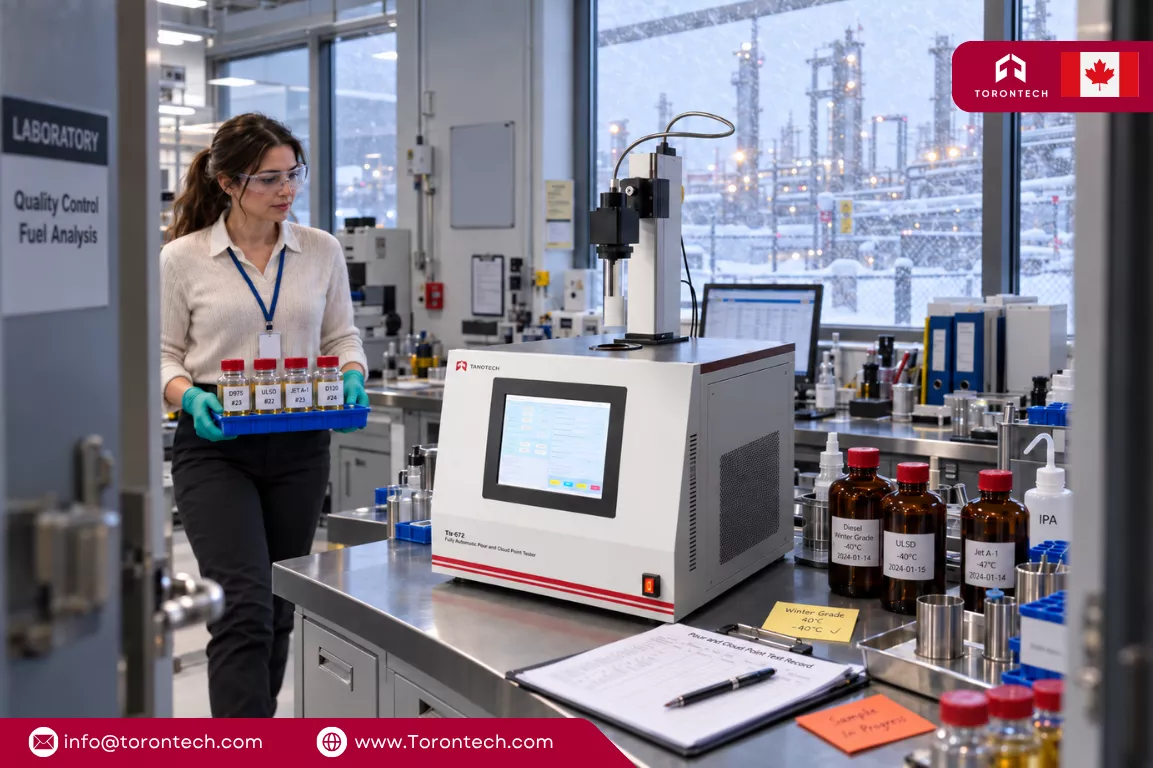
A pour and cloud point tester in Canada gives refineries, terminals, and lubricant blenders that data on demand. Torontech supplies a full range of pour point and cloud point testing instruments, from metal bath units to fully automatic analyzers, supported from our Toronto office.
Why Canadian Fuel Specs Demand Reliable Cold-Flow Data
Canada does not set one winter number for diesel. Instead, CAN/CGSB-3.517 ties low-temperature operability to the 2.5% low-end design temperature for each location and period of use. Weather statistics drawn from three decades of hourly readings define that limit.
When the design temperature falls below -48°C, suppliers may deliver fuel meeting a -48°C operability limit. Under the standard, labs establish operability through cloud point, with ASTM D5773 as the referee method, or through the low-temperature flow test.
As a result, a single refinery may blend several winter grades for different delivery zones. Each grade needs fast, repeatable cloud point screening before it leaves the tank farm. Pour point data then supports storage, pumping, and heating oil decisions.
Renewable Content Is Raising the Stakes
The federal Clean Fuel Regulations require primary suppliers to cut the carbon intensity of diesel and gasoline, tightening the target to 14 gCO2e/MJ below 2016 levels by 2030. Provinces add their own renewable content rules on top.
British Columbia, for example, raised its renewable diesel requirement from 4% to 8% on April 1, 2025, under its Low Carbon Fuel Standard. Meanwhile, Imperial began producing renewable diesel at its Strathcona refinery near Edmonton in July 2025, with a planned capacity of 20,000 barrels per day.
Blend chemistry now matters more than ever. Industry submissions to Ontario's regulator note that biodiesel typically clouds near 0°C, while renewable diesel sits closer to -20°C. Consequently, blenders working under CAN/CGSB-3.522 for B6 to B20 fuels need to verify the cloud point of every seasonal blend.
Matching a Pour and Cloud Point Tester in Canada to Your Lab
Torontech offers four configurations, each suited to a different testing workload. The table below compares their core capabilities as listed on each product page.
| Model | Parameters | Low-Temperature Range | Typical Fit |
|---|---|---|---|
| Fully Automatic Pour and Cloud Point Tester | Cloud and pour point in one cycle | Down to -80°C, no external chiller | Refinery and third-party labs |
| Metal Bath Pour and Cloud Point Tester | Cloud and pour point, two stations | -70°C to ambient | Lubricant blenders, routine QC |
| Pour Point & Solidifying Point Tester | Pour and solidifying point, two positions | Down to -70°C | Lube oils, dark petroleum products |
| Pour Point, Freezing Point & Cold Filter Point Tester | Pour point, freezing point, expandable CFPP unit | Down to -70°C | Diesel, jet fuel, biodiesel blends |
The fully automatic model meets ASTM D97, ASTM D2500, ASTM D5950, ISO 3015, and ISO 3016. It uses optical detection to remove observer judgment and reports results at 0.1°C resolution. Furthermore, its LAN port supports LIMS integration for high-volume terminals.
The metal bath unit meets ASTM D97 and ASTM D2500 without any liquid cooling medium. Two test stations run at different temperatures, which suits labs that test both summer and winter grades.
Applications Across Canada's Cold-Climate Sectors
Low-temperature testing reaches well beyond the refinery gate. Canadian buyers typically apply these instruments to the following products:
- Aviation fuel: CAN/CGSB-3.23 caps the freezing point of Jet A-1 at -47°C and Jet A at -40°C. The FPC 1000 determines freezing point to ASTM D2386.
- Hydraulic fluids: Mining, forestry, and construction fleets need fluids that still flow during deep-winter cold starts.
- Engine and gear oils: Lubricant manufacturers report pour point on product data sheets for cold-start protection.
- Heating oil: Pour point supports reliable pumping from outdoor residential and commercial tanks.
Practical Selection Points for Canadian Buyers
Before requesting a quote for a pour and cloud point tester in Canada, confirm a few site and workflow details. These points prevent surprises during commissioning:
- Power supply: All four models list a 110V option alongside the 220V standard configuration.
- Lab environment: The metal bath unit requires ambient temperatures at or below 30°C, while the FPC 1000 specifies a 10 to 28°C operating range.
- Data handling: Ethernet, RS-232, and USB interfaces on the ToronPP models simplify audit trails for regulated suppliers.
- Throughput: Dual detection positions let busy labs run two samples simultaneously during peak winter blending.
Prepare Your Lab Before the Next Winter Grade Changeover
Seasonal transitions compress testing schedules across Canada. Labs that validate cold-flow methods before autumn blending begins avoid bottlenecks when every grade needs fresh cloud point data.
Torontech Inc. operates from Toronto, so Canadian customers work with a local team for configuration, installation planning, and after-sales support. Our specialists can help match cooling depth and parameters to your product slate.
Reach out to the Torontech team to plan your low-temperature testing setup. You can also call +1 416 368 2721, email sales@torontech.com, or contact support@torontech.com for service. Visit us at 251 Consumers Road, Suite #1200, Toronto, Ontario, M2J 4R3.


