
Stop Sand-Driven Wear With an Oil Particle Counter in Algeria
In the Algerian Sahara, fine sand finds every breather cap, worn seal, and open drum. Once those hard particles reach hydraulic oil or turbine lubricant, they grind pumps, score valves, and shorten bearing life long before a warning light appears.
An oil particle counter in Algeria gives maintenance teams the numbers to catch that damage early. Torontech's ToronOPC liquid and oil particle counter series uses laser light-blocking detection to size and count solid contaminants, so you act on measured cleanliness instead of fixed oil-change intervals.
Why Fluid Cleanliness Is Hard to Hold in Algeria
Most of the country's energy assets sit in desert terrain. Fields such as Hassi Messaoud and Hassi R'Mel, along with remote wellsites in Illizi, run equipment under sirocco winds that carry abrasive dust into reservoirs and fill points.
Heat compounds the problem. High ambient temperatures thin lubricants and speed up oxidation, while long supply routes make every unplanned pump or servo valve replacement expensive. Field crews therefore need contamination data on site, not weeks later from a distant laboratory.
Three local conditions shape what a buyer should look for:
- Abrasive dust ingress: particles close in size to dynamic clearances cause the most wear in pumps, valves, and actuators.
- Remote sites: portable, battery-powered instruments reduce dependence on central labs and courier schedules.
- Coastal humidity: refineries and power stations near Arzew, Skikda, and Algiers face moist air that adds water to oil.
Where Contamination Monitoring Pays Off
Algeria's investment pipeline puts more hydraulic and rotating equipment into service every year, which widens demand for an oil particle counter in Algeria. The table below links each sector to its current demand driver and the fluids that matter most.
| Sector | Current Driver | Fluids to Monitor |
|---|---|---|
| Upstream oil and gas | Sonatrach's $60 billion 2025 to 2029 plan, with about 80% aimed at exploration and production | Hydraulic oil, compressor and gear lubricants |
| Power generation | Sonelgaz capacity above 27,000 MW, almost entirely gas-fired | Turbine oil, transformer oil |
| Mining and rail | The 950 km Gara Djebilet to Béchar railway, commissioned in February 2026 | Hydraulic oil, engine oil, gear oil |
| Steel | Iron ore shipments feeding Tosyali Algérie near Oran | Hydraulic oil in mills and presses |
| Refining and petrochemicals | Roughly $7 billion earmarked for downstream modernization | Lubricants, fuels, process fluids |
Power utilities deserve special attention. Sonelgaz has added mobile gas turbines in southern communes such as Debdeb and Bordj Badji Mokhtar, where turbine lubricant faces dust and extreme heat with limited service support nearby.
Mining follows a similar pattern. Haul trucks, loaders, and locomotives on the new western mining corridor operate far from workshops. A quick cleanliness check during routine servicing keeps a failing hydraulic pump from stranding equipment in the desert.
Choosing an Oil Particle Counter in Algeria by Application
The ToronOPC range covers laboratory, field, and online duty. Match the format to where your samples come from and how quickly you need results.
- Central or contract laboratories: the benchtop ToronOPC 100 oil particle counter measures 0.5 to 600 µm across 24 channels and handles samples up to 650 cSt.
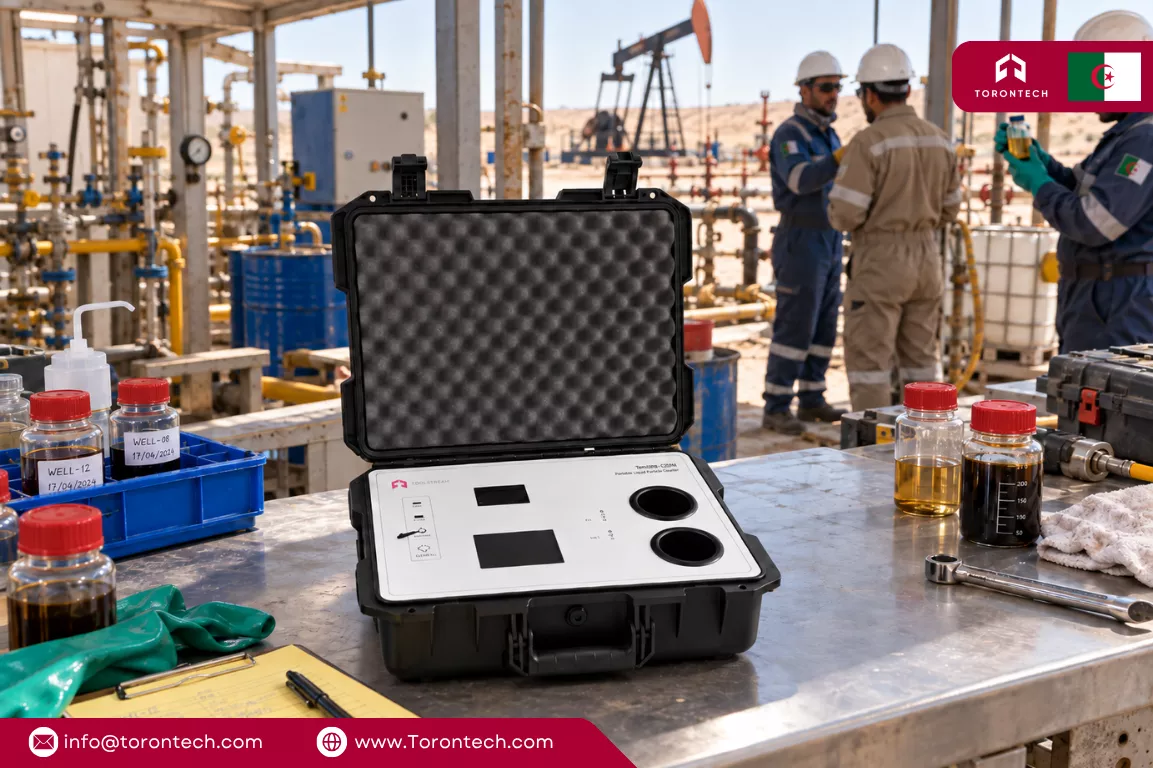
- Wellsites, mines, and rail depots: the portable ToronOPC 300W runs on a lithium battery, operates from -20 °C to 60 °C, and detects water content from 10 to 500 ppm.
- Turbines and critical hydraulics: the ToronOPC 550 online particle counter samples every 1 second to 24 hours and accepts 24 VDC for skid or panel mounting.
Online monitoring suits unmanned or remote assets. A continuous trend reveals a failing filter long before a scheduled bottle sample would, which matters when the nearest technician is hours away.
The range also includes the ToronOPC OL2 online unit, the ToronOPC 300 and VES counters, and a standalone particle counter sensor for integration into existing test benches and flushing rigs.
Reporting to the Codes Your Specifications Already Use
Algerian operators work alongside European, American, Asian, and Gulf partners, so cleanliness targets arrive written in different codes. ToronOPC instruments report results in the formats those contracts typically specify.
According to their product pages, the ToronOPC 100 and 300W support:
- ISO 4406: three-number cleanliness codes based on counts at 4, 6, and 14 µm(c)
- NAS 1638 and SAE AS4059: cleanliness classes widely used for hydraulic and aerospace fluids
- ISO 11171 and ISO 4402: calibration references for automatic particle counters
- GOST 17216: classification for fleets that follow Russian specifications
Because the instruments express one test in several codes, a single sample can satisfy an OEM warranty requirement and an internal reliability target at once. In addition, multiple calibration curves, including ACFTD and ISO MTD, keep new results comparable with historical data.
Get Configuration Support From Torontech's Regional Office
From Saharan wellsites to coastal refineries, Algerian assets fail when abrasive contamination goes unmeasured. Reliable cleanliness data turns oil analysis into a planning tool instead of a post-failure investigation.
Torontech serves North Africa through Torontech ME FZE in Dubai. Our regional team helps Algerian buyers choose between lab, portable, and online formats, select calibration curves, and plan integration with existing plant monitoring systems.
Share your fluid types, viscosity range, and site conditions, and reach out to the Torontech team for a configuration proposal. You can also email me@torontech.com, call +971 488 19252, or visit Meydan Grandstand, 6th floor, Meydan Road, Nad Al Sheba, Dubai-261440, UAE.


