
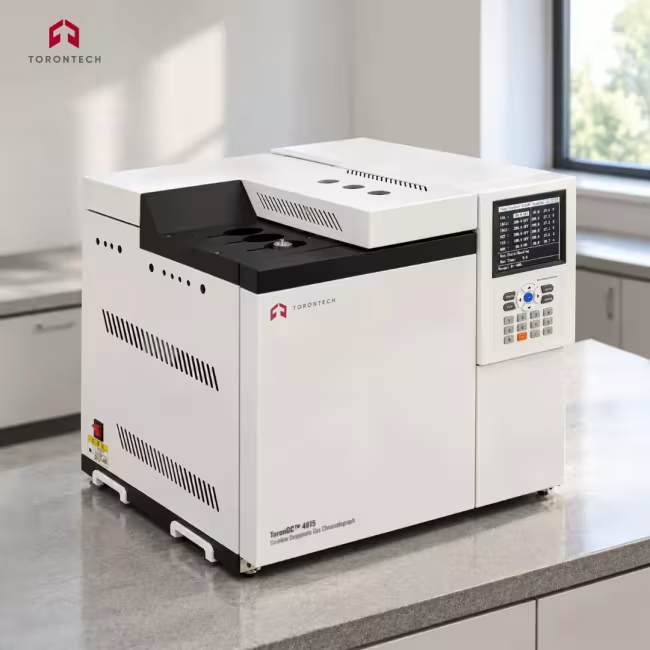
Gasoline Oxygenate Gas Chromatograph
Gasoline Oxygenate Gas Chromatograph - ToronGC™ 4815
The ToronGC™ 4815 Gasoline Oxygenate Gas Chromatograph measures ethers and alcohols in finished motor gasoline for refineries, fuel terminals, and testing laboratories. It follows the method in ASTM D4815 for MTBE, ETBE, TAME, DIPE, tertiary-amyl alcohol, and C1 to C4 alcohols. Blenders add these oxygenates to raise octane and cut tailpipe emissions. Their type and concentration are regulated, so labs need accurate numbers before fuel reaches the market. Oxygenate levels also influence drivability, vapor pressure, phase separation, and evaporative emissions.
Torontech builds the ToronGC™ 4815 around a polar TCEP precolumn, a high-temperature ten-port backflush valve, and a flame ionization detector (FID). The precolumn holds back the oxygenates while light hydrocarbons pass through and vent. A 50 m capillary column then separates the target compounds for quantitation. The same hardware supports aromatics analysis under ASTM D5580, so one platform covers two common gasoline methods. The system accepts up to three detectors for future expansion.
Six independent temperature zones with seven-stage programming let analysts tune each method precisely. Self-diagnostics and over-temperature protection guard the instrument during long unattended sequences. The package includes a calibration standard, chromatography workstation software, and hydrogen and air generators. Labs can begin validated testing soon after installation. Torontech supplies the ToronGC™ 4815 to fuel laboratories.
Gasoline Oxygenate Gas Chromatograph - ToronGC™ 4815 Applications
The ToronGC™ 4815 serves operations that blend, certify, or regulate oxygenated gasoline. Typical users include the following industries and laboratories.
- Refinery Quality Control: verifies ether and alcohol content in blend streams before release to confirm oxygen specifications for reformulated gasoline
- Fuel Terminals and Blending Operations: checks ethanol, MTBE, and other oxygenate ratios during splash blending or in-line injection
- Independent Testing Laboratories: runs ASTM D4815 and D5580 analyses for certificates requested by fuel marketers and regulators
- Regulatory and Environmental Monitoring: supports oxygenate and benzene reporting under reformulated gasoline programs
- Oxygenate Manufacturing: confirms purity and concentration of MTBE, ETBE, TAME, and alcohol blending components
- Petrochemical Research and Development: characterizes experimental gasoline formulations and alternative oxygenate packages
- Cargo and Custody Transfer Inspection: checks oxygenate and aromatic content of gasoline cargoes against contract specifications

Standards
The ToronGC™ 4815 is designed to align with ASTM test methods for oxygenate and aromatic analysis in gasoline by gas chromatography. Laboratories should confirm conformance against the current edition of each standard during installation and calibration.
- ASTM D4815 - Standard Test Method for Determination of MTBE, ETBE, TAME, DIPE, tertiary-Amyl Alcohol and C1 to C4 Alcohols in Gasoline by Gas Chromatography
- ASTM D5580 - Standard Test Method for Determination of Benzene, Toluene, Ethylbenzene, p/m-Xylene, o-Xylene, C9 and Heavier Aromatics, and Total Aromatics in Finished Gasoline by Gas Chromatography
Gasoline Oxygenate Gas Chromatograph - ToronGC™ 4815 Key Features
The ToronGC™ 4815 combines a dedicated oxygenate column set with laboratory-grade temperature control and safety functions. Each feature below supports reliable, repeatable fuel analysis.
- TCEP Precolumn and Ten-Port Backflush: removes light hydrocarbons before the analytical column so oxygenate peaks stay free of interference
- Dual-Method Platform: runs ASTM D4815 oxygenates and ASTM D5580 aromatics on the same instrument, which reduces capital and bench space
- Six Independent Temperature Zones: controls the vaporization chamber and capillary vaporization chamber separately, with seven-stage programmed heating for method flexibility
- English-Language LCD Display: shows real-time temperature and status for every zone so operators can confirm conditions at a glance
- Power-On Self-Diagnostics: runs a self-test at startup and monitors for faults continuously, then locates the problem and sounds an alarm
- Over-Temperature Protection: shuts down heating and raises an alarm if any zone exceeds its set point
- Vertical Vaporization Chamber: limits heat transfer into the oven for more consistent retention times
- Automatic Rear-Door Cooling: adjusts the oven door angle to bring the column back near ambient quickly between runs
- Flexible Injection Ports: accept packed columns, glass liners, and capillary split/splitless injection, with septum cleaning and an optional gas sampling valve
- Expandable Gas Path: delivers stable carrier and detector gas to as many as three detectors
- Complete Starter Package: ships with a calibration standard, workstation software, and hydrogen and air generators
Theory and Method
Gasoline holds a small share of polar oxygenates within a large volume of nonpolar hydrocarbons. A single column cannot separate them cleanly, because many hydrocarbons elute at the same time as the target ethers and alcohols. The ToronGC™ 4815 solves this with a two-column backflush design. The sample first enters a polar TCEP precolumn, which retains oxygenates strongly while light hydrocarbons pass through quickly. These hydrocarbons vent before they reach the analytical column.
The ten-port valve switches flow at a preset time and reverses the carrier gas through the precolumn. This backflush sends the retained oxygenates and heavier hydrocarbons onto the capillary analytical column. There, the compounds separate by boiling point and polarity into distinct peaks. Retention time identifies each compound. The same two-column approach runs ASTM D5580, where the valve timing vents ethers and light alcohols so they do not interfere with the aromatic results.
The flame ionization detector burns the column effluent in a hydrogen and air flame. Carbon-containing molecules form ions, and a collector electrode measures the resulting current. That current scales with carbon content, which gives the FID high sensitivity for both oxygenates and aromatics. The workstation integrates each peak and compares it with a calibration standard to report concentration. Dedicated hydrogen and air generators keep the flame stable for repeatable quantitation.
Gasoline Oxygenate Gas Chromatograph - ToronGC™ 4815 Technical Specifications
Parameter | ToronGC™ 4815 |
Test Methods | ASTM D4815, ASTM D5580 |
External Dimensions (L × H × W) | 500 × 480 × 470 mm |
Column Oven Dimensions (L × H × D) | 240 × 250 × 155 mm |
Column Installation Spacing | 152.4 mm (6-inch standard interface) |
Instrument Weight | 40 kg |
Oven Temperature Range | Ambient +8°C to 400°C, 1°C setting increment |
Temperature Control Zones | 6 independent zones, 7-stage programmed heating |
Programmed Heating Rate | 0.1 to 50°C/min, 0.1°C/min increment |
Programmed Hold Time | User-defined |
Temperature Stability | ±0.1°C with 10°C ambient change or 10% supply voltage change |
Temperature Gradient | ±1% (100°C to 350°C) |
Detector | FID |
FID Detection Limit | ≤1 × 10⁻¹¹ g/s (benzene) |
FID Noise | ≤0.02 mV |
FID Drift | ≤0.1 mV/h |
Injection System | Split/splitless capillary injector (SPL) |
Backflush Valve | High-temperature ten-port valve (VICI) |
Precolumn | TCEP precolumn (Restek column hardware) |
Analytical Column | Capillary, 50 m × 0.53 mm × 3.0 µm |
Maximum Detectors | 3 |
Operating Ambient Temperature | 5°C to 35°C |
Relative Humidity | ≤85% |
Power Supply | 220 V AC ±10%, 50 Hz ±0.5 Hz |
Maximum Power Consumption | 2000 W |
Standard Configuration
Item | Quantity | Description |
Gas Chromatograph Main Unit | 1 | English LCD, power-loss parameter memory, self-diagnostics, over-temperature alarm, automatic rear-door cooling |
Detector | 1 | FID, detection limit ≤1 × 10⁻¹¹ g/s (benzene), noise ≤0.02 mV, drift ≤0.1 mV/h |
Injection System | 1 | Split/splitless capillary injector (SPL) |
Backflush Switching System | 1 | High-temperature ten-port valve (VICI) |
Precolumn | 1 | TCEP precolumn |
Analytical Column | 1 | Capillary column, 50 m × 0.53 mm × 3.0 µm |
Calibration Standard | 1 | Oxygenates-in-gasoline standard sample |
Workstation | 1 | Chromatography data acquisition and processing software |
Hydrogen Generator | 1 | High-purity hydrogen, 99.995% |
Air Generator | 1 | Dry, oil-free zero air |
