
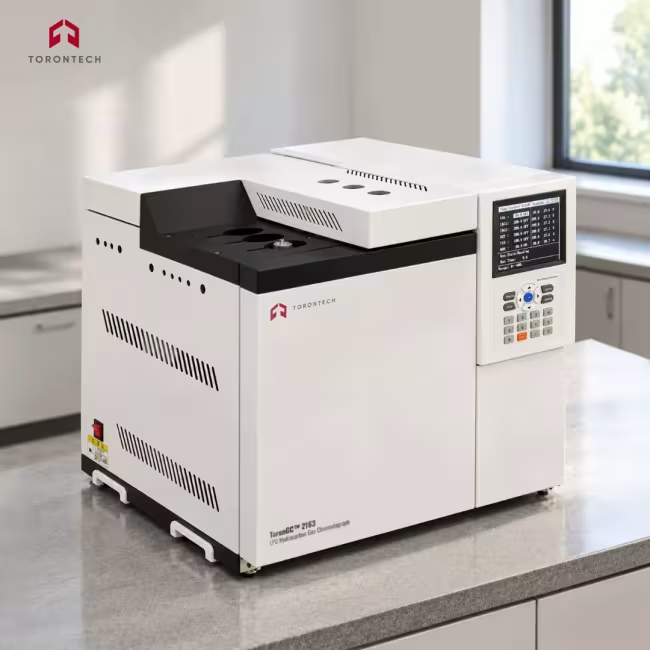
LPG Hydrocarbon Gas Chromatograph
LPG Hydrocarbon Gas Chromatograph - ToronGC™ 2163
The ToronGC™ 2163 LPG Hydrocarbon Gas Chromatograph measures the individual hydrocarbons in liquefied petroleum gas and propane/propene mixtures for refineries, gas plants, and LPG terminals. It follows the test method described in ASTM D2163. The system quantifies C1 through C5 hydrocarbons, excluding alkynes, in a single injection. Producers use the results to confirm product grade before shipment. Inspection laboratories rely on the same data to verify cargo quality at import and export points.
Torontech builds the ToronGC™ 2163 around two chromatographic columns and two detectors. A flame ionization detector (FID) handles the hydrocarbons, while a thermal conductivity detector (TCD) reads nitrogen. A double six-way valve injects the sample into both channels at the same time without cross-interference. Multi-step temperature programming separates closely eluting isomers and shortens the total run. Standard Gas Mixture Included in 4 L aluminum cylinders support routine quantitative calibration.
Accurate composition data matters because LPG serves as both fuel and chemical feedstock. Trace levels of olefins or dienes can affect cracker performance, polymer production, and combustion behavior. The ToronGC™ 2163 resolves these minor components alongside the main propane and butane peaks. A dual-channel chromatography workstation stores each chromatogram, processes the data, and prints the report. Torontech supplies this system to laboratories across the United States and Canada.
LPG Hydrocarbon Gas Chromatograph - ToronGC™ 2163 Applications
The ToronGC™ 2163 serves any operation that produces, trades, or consumes LPG on the basis of its hydrocarbon composition. Typical users include the following industries and laboratories.
- Refinery LPG Production: verifies propane, butane, and olefin content of LPG streams before they move to storage or blending
- Gas Processing and NGL Fractionation: checks the purity of propane and butane cuts leaving the fractionation train
- Import and Export Commodity Inspection: provides ASTM D2163 composition reports for custody transfer and cargo acceptance at marine and rail terminals
- Petrochemical Feedstock Qualification: measures propylene, butenes, and 1,3-butadiene in feed to steam crackers and polymer units
- LPG Distribution and Bottling Plants: confirms that delivered product meets the grade printed on supply contracts
- Autogas and Fuel Quality Programs: tracks propane and butane ratios that affect vapor pressure and engine performance
- Third-Party Testing Laboratories: runs routine LPG composition analysis for producers, traders, and regulators
- Research and Method Development: supports evaluation of new separation conditions and calibration gas blends

Standards
The ToronGC™ 2163 is designed to align with the ASTM test method for determining hydrocarbons in LPG and propane/propene mixtures by gas chromatography. Laboratories should confirm conformance against the current edition of the standard during installation and calibration.
- ASTM D2163 - Standard Test Method for Determination of Hydrocarbons in Liquefied Petroleum (LP) Gases and Propane/Propene Mixtures by Gas Chromatography
LPG Hydrocarbon Gas Chromatograph - ToronGC™ 2163 Key Features
The ToronGC™ 2163 combines a dedicated column and detector layout with practical calibration and data tools. Each feature below supports fast, repeatable LPG composition analysis.
- Dual FID and TCD Detection: covers hydrocarbons and nitrogen in one system, so the lab avoids running the sample on a second instrument
- Two-Column Separation: resolves the full C1 through C5 component list from a single sample for a complete composition report
- Double Six-Way Injection Valve: loads both channels at once without cross-interference, which keeps the two results consistent
- Multi-Step Temperature Programming: separates closely eluting butane and butene isomers while cutting total analysis time
- Wide Concentration Coverage: quantifies major and trace components
- Standard Gas Mixture Included: 4 L aluminum cylinders of calibration gas let the lab start quantitative work on delivery
- Dual-Channel Chromatography Workstation: stores chromatograms, processes data, and prints reports for quality records
- Olefin and Diene Measurement: reports propylene, butenes, and 1,3-butadiene for petrochemical feedstock control
Theory and Method
Gas chromatography separates a vaporized sample by passing it through a column with a carrier gas. Each hydrocarbon interacts with the stationary phase to a different degree, so it leaves the column at a characteristic retention time. Light compounds such as methane and ethane elute first. The butane and butene isomers follow, and the pentanes come off last. The retention time identifies each component, and the peak area reflects its concentration.
The flame ionization detector burns the column effluent in a hydrogen and air flame. Carbon-containing molecules form ions in the flame, and a collector electrode measures the resulting current. That current scales with the number of carbon atoms reaching the detector, which gives the FID strong sensitivity for hydrocarbons. Nitrogen does not ionize in the flame, so the second channel uses a TCD. The TCD detects nitrogen through the change in heat transfer between carrier gas and sample gas.
The ToronGC™ 2163 runs both channels from one injection through a double six-way valve. Multi-step temperature programming raises the column oven in stages, which sharpens early peaks and speeds the elution of heavier compounds. The data system compares each sample peak with the response from a standard mixture of known composition. It then reports the concentration of every component. Hydrocarbons heavier than C5 and non-hydrocarbon impurities fall outside the scope of this method and may need separate tests.
Chromatogram

LPG Hydrocarbon Gas Chromatograph - ToronGC™ 2163 Technical Specifications
Parameter | ToronGC™ 2163 |
Test Method | ASTM D2163 |
Sample Type | LPG and propane/propene mixtures (excluding high-purity propene) |
Hydrocarbon Range | C1 to C5, excluding alkynes |
Detectors | FID (hydrocarbons) and TCD (nitrogen) |
Columns | 2 chromatographic columns |
Injection | Gas six-way valve and double six-way valve for simultaneous sampling |
Oven Control | Multi-step temperature programming |
Components Measured (FID) | Methane, ethane, ethene, propane, propylene, isobutane, n-butane, 1-butene, isobutene, cis-2-butene, trans-2-butene, 1,3-butadiene, isopentane, n-pentane |
Components Measured (TCD) | Nitrogen (air) |
Method Scope | 0.01 to 100 volume percent per component |
Concentration Range | 100 ppm to 50% |
Calibration Standard | Standard gas mixture in 4 L aluminum cylinders |
Data System | Dual-channel chromatography workstation with chromatogram storage, data processing, and report printing |
Exclusions | High-purity propane, alkynes, hydrocarbons heavier than C5, and non-hydrocarbon materials |
